
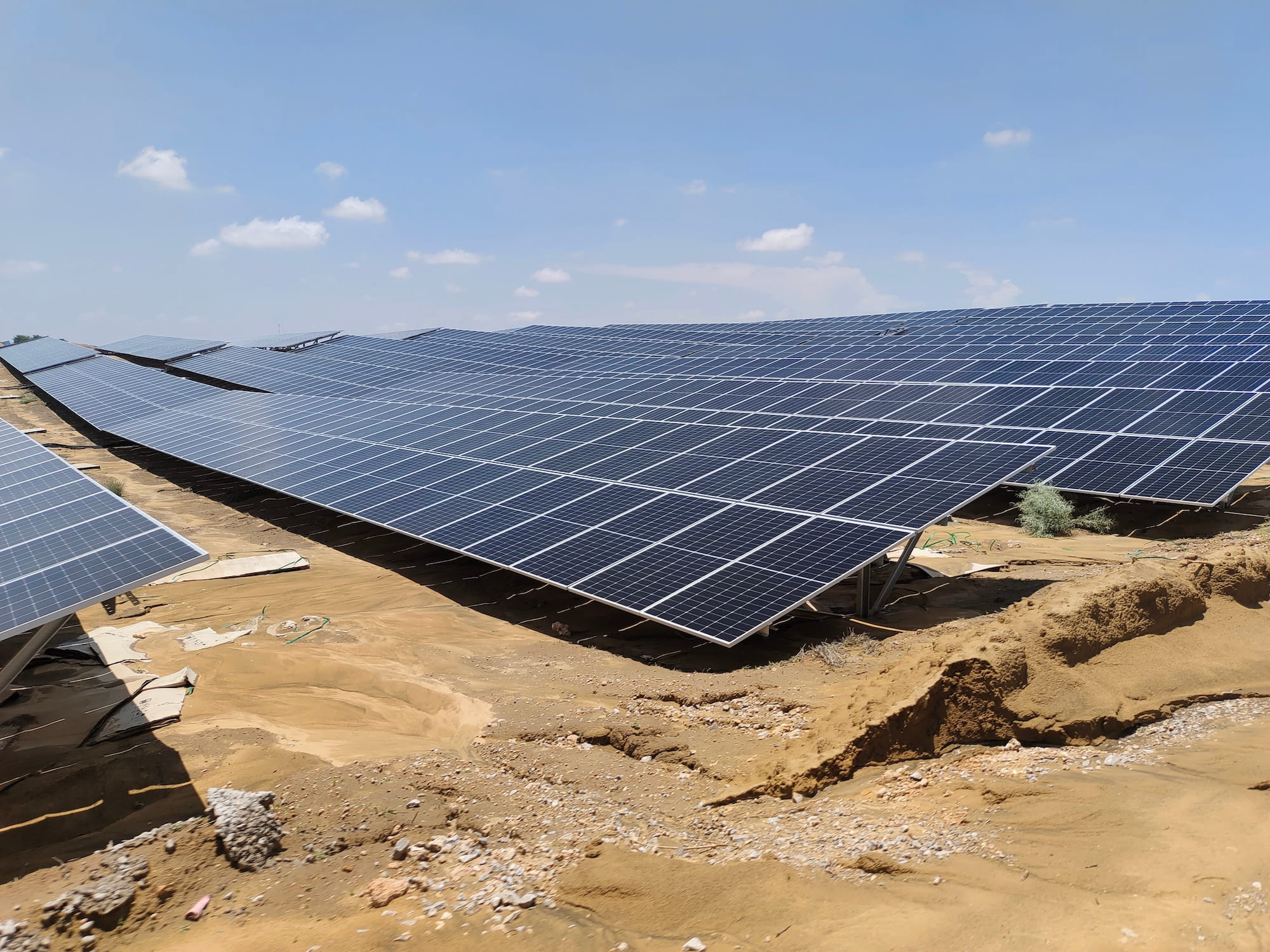
In this blog, TEA@SUNRISE delivery partner Dr Deepika Swami (IIT Kanpur) explains the importance of circular economy thinking in the delivery of India’s solar energy transition.
The new face of energy insecurity
Energy security for decades meant reducing dependence on oil. But now, it is the era of a new and modern energy transition, which means something broader than just oil and gas. As countries race to deploy solar panels, wind turbines, batteries, and electric vehicles, they are building a clean energy system that runs not on fossil fuels but on critical minerals: lithium, cobalt, nickel, rare earths, aluminium, and silicon. Most of these minerals are geographically concentrated and their refining and processing is dominated overwhelmingly by China. India imports roughly 85% of its crude oil. It also has a high import dependency on China for materials to be used in making solar panels. Trading one import dependence for another is not energy security, it is a change of address for the same vulnerability.
This is where circular economy thinking becomes strategically essential. A circular economy treats end-of-life material not as waste but as a domestic secondary resource. Recovering aluminium from solar panels, copper from wind turbines, and lithium from batteries reduces the demand for virgin imports, dampens exposure to price shocks, and creates domestic industrial value from what would otherwise be a disposal problem. Energy security and circular economy are therefore two sides of the same coin in the modern energy transition: where one addresses how energy is produced, the other addresses how the produced materials are managed.
Perovskites: Solution or a new kind of environmental emergency for India?
India is the world’s third largest renewable energy producer and has built over 135 gigawatts of solar capacity, almost entirely from crystalline silicon solar modules imported from China. Making silicon solar cells requires polysilicon purified to 99.9999%, grown into ingots at 1,400 degrees Celsius, sliced into wafers, and processed through energy-intensive semiconductor fabrication. This supply chain is capital-intensive, and China has spent two decades building the manufacturing depth that makes it nearly impossible to displace quickly.
Owing to these complexities and dependence on China for energy security, Perovskite solar cells (PSCs) offer India and other countries an energy secure pathway and future. Their active layers are deposited from solution at low temperatures using relatively simple coating equipment. Their primary structural materials, glass and aluminium are abundantly available domestically. India could build indigenous perovskite manufacturing without replicating China’s silicon supply chain, transforming the solar value chain from an imported technology into a home-grown capability. With laboratory efficiencies already exceeding 26% and tandem cells crossing 34%, perovskite technology is not a distant promise any more, it is approaching commercialisation at a rapid rate. For India, it represents both a technological leap and a strategic opportunity to reclaim supply chain sovereignty in clean energy.
However, while Perovskite solar cells are critical from the energy security perspective, they have a few underlying issues. Under real outdoor conditions, they currently last only 3 to 5 years, compared to 25 to 30 years for silicon. This short lifetime transforms the waste problem entirely. A silicon panel installed today becomes waste in 2050. A perovskite panel installed in 2027 becomes waste in 2030 and the next one in 2033. The replacement cycle is rapid and continuous. Critically, perovskite modules contain lead-based absorber materials. Unlike silicon PV, where the 25-year lifetime gives society decades to build recycling infrastructure, perovskite waste arrives almost simultaneously with the deployment. India needs collection networks, authorised dismantling facilities, and dedicated material recovery plants ready by 2030 if commercial PSC deployment begins in 2027. The infrastructure must precede the waste, not follow it.
Circular economy modelling research from IIT Kanpur
The research team at IIT Kanpur, led by Prof. Deepika Swami developed an integrated framework combining dynamic material flow analysis, circular economy modelling, and techno-economic assessment to model India’s perovskite waste future from 2027 to 2033. Using a Weibull probability distribution with a mean module lifetime of 3 years, the research work projected an annual end-of-life waste reaching 0.19 million tonnes per year under a conservative deployment scenario and 0.32 million tonnes per year under a moderate scenario by 2033. Fig. 1 shows the conservative and moderate scenarios.
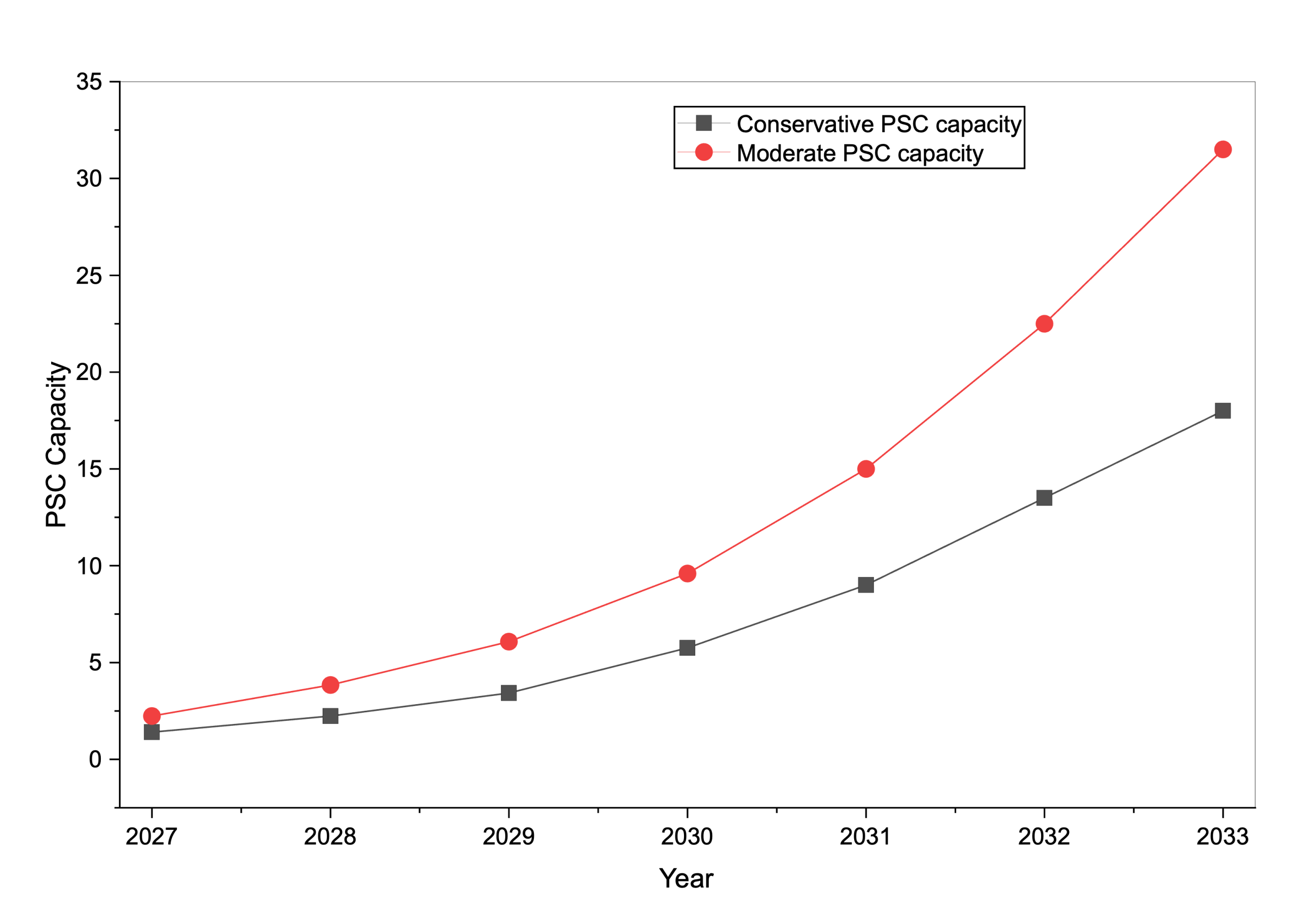
Lead in this waste stream reaches 32.4 and 54.4 tonnes per year respectively, quantities that clearly place PSC waste in the hazardous category. The framework quantifies what can be recovered, what the environmental benefit of recovery is, and whether circular PSC management is economically viable in India.
Policy suggestions at national and state level: Evidence from data and modelling
Broadly, India urgently needs an Extended Producer Responsibility (EPR) framework specifically covering solar photovoltaic panels. EPR would require manufacturers and importers to register with the Central Pollution Control Board (CPCB), set annual collection targets, and recycling operations. Alongside, PSC panels should be explicitly classified as hazardous waste, triggering controlled management obligations and preventing informal disposal. At the global level, India should engage in the International Solar Alliance to develop harmonised standards for PSC material composition disclosure and end-of-life management.
At state and district scale, regional collection centres co-located with existing industrial estates in Rajasthan, Gujarat, and Tamil Nadu would minimise transport costs. A deposit-refund mechanism, a small fee at point of sale to be refunded when panels are returned to authorised collection points, would create direct financial incentives for proper disposal by rooftop owners and small installers.
Economics and finances
Under a baseline scenario without specific policy support, the Net Present Value (NPV) is Rs.120 crore with an Internal Rate of Return (IRR) at 12%, with a payback period of 16.5 years. This scenario looks marginally viable from the financial perspective. Under a policy-supported scenario incorporating EPR and improved collection, NPV rises to Rs. 350 crore and IRR reaches 24%. Under an advanced recycling scenario with process optimisation and economies of scale, NPV reaches Rs. 580 crore, IRR climbs to 38 percent, and the payback period drops to 6 years, depicting high profitability with the support from dedicated policies.
By 2033, the moderate scenario recovers 16,700 tonnes of aluminium per year, avoiding approximately 2.6 million tonnes of CO₂ that would have resulted from primary aluminium production. The total annual CO₂ avoided from all material recovery exceeds 3 million tonnes by 2033, equivalent to taking roughly 65,000 cars off Indian roads. Energy saved from aluminium recycling alone exceeds 885 million kilowatt-hours per year, enough to power hundreds of thousands of Indian homes.
The way forward for research teams and technology developers
Research into better encapsulation, more stable perovskite compositions using caesium or formamidinium rather than methylammonium, and more robust hole transport materials is progressing rapidly. Second, investment in lead-free materials research is essential, but in the near term, the answer is containment through circular management rather than elimination. Third, collection logistics are required at massive scale. PSC installations will be dispersed across urban rooftops, rural farms, and remote areas. Building collection systems that are accessible, affordable, and used by small installers requires both financial incentives and administrative simplicity.
Institutional strengthening and future roadmap
India stands at a fork in the road. One direction leads to a perovskite future that solves the problem of energy security using imported materials, but leads to a mounting waste problem with no management system, and lead entering groundwater across rural India. In the other direction lies a solution that is derived from a circular economy, which can help recover secondary materials, reduce import dependence, and create recycling industry jobs and industrial value from what would otherwise be a liability.
The difference between these futures is not technology. It is timing. Policy frameworks must be established before deployment scales. Recycling infrastructure must be built before waste arrives. What India needs now is the institutional strengthening and will to act before the sun sets on the first generation of perovskite panels.

This article was written by Dr Deepika Swami (dswami@iitk.ac.in), an Assistant Professor at IIT Kanpur India.
This work was done in collaboration with TEA@SUNRISE, a project funded by the Transforming Energy Access platform. TEA is funded by the UK government’s Foreign, Commonwealth & Development Office (FCDO) through its Global Research and Technology Development (GRTD) portfolio, and is part of the UK’s Ayrton Fund. However the views expressed do not necessarily reflect the UK government’s policies.