
Perovskite solar cells are much more tolerant to dust contamination in the manufacturing process than we assumed. This is good news for local manufacturing in low- and middle-income countries, because it suggests that perovskites can be fabricated under less controlled, and therefore less expensive, environments. These findings are from a new paper by Kathryn Lacey et al, which evaluates the effects of dust on planar perovskite devices. Below, Kathryn (Kat) answers our questions about her research.
1. Why is dust typically a problem when manufacturing solar modules?
Kat: Solar cells are typically made using ultra-thin layers interacting together to absorb light and generate current. These layers can be less than a micron in thickness. In general, better uniformity in these layers means more consistent device function. Dust particles have the potential to cause a variety of problems in perovskite solar cells such as holes, changes in thickness or disconnects in these deposited layers. In turn, these issues could potentially reduce the area of the device which effectively transports current or cause areas where device degradation may begin or be exacerbated. The thinner or more fragile the layers, the more significant these effects can be.
2. How controlled is the current manufacturing process for silicon solar panels?
Kat: Silicon solar panels are made using ultra-thin films where the introduction of dust particles on a similar size scale has the potential to reduce the devices’ ability to absorb light and generate current effectively. The type of layer deposition and the materials used for these devices, as with many types of semiconductors, are highly vulnerable to defects caused by particulates. These defects can impact significantly on a silicon device. They are therefore made in cleanroom environments (typically class 5 or 6) to allow a strong control over the level of dust permitted in the manufacturing environment.
3. How did you evaluate the effect of dust on the perovskite devices?
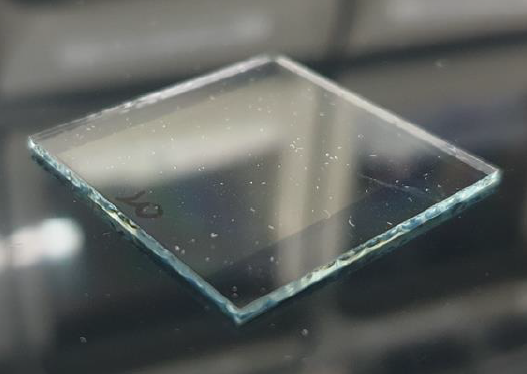
Kat: We set up an experiment using an enclosed transparent box with a particle counter and industrial household test dust (typically used in factories for testing products such as filters). Perovskite solar cells are made by depositing ultra-thin layers of chemicals which can interact to generate current when light is absorbed. As each layer was deposited in liquid form, we placed the devices in the box and circulated dust over them using airflow to create an even deposition of dust particles. From there, we made the devices as normal, continuing to deposit layers over top of the dust. We then tested and compared these with control devices which were made outside of the dust box at the same time.
4. What were the results? Did they surprise you?
Kat: We expected that device performance would be immediately reduced on the introduction of any dust particles. From there, we would conduct analysis to assess whether this resulted from a reduction in light absorption, interruption in current flow or any other mechanisms. Unexpectedly however, there was almost no change in device performance compared to the controls, despite the visible dust particles left on the ultra-thin layers when making contaminated devices.
Perovskite is a light-absorbing layer deposited in chemical solution form, then subjected to heat to allow the liquid to evaporate off and the perovskite to form a consistent layer of crystals. When viewed at the nanoscale under electron microscope we could see that perovskite crystals grew around the dust particles with very little interruption or change to the crystal structure.
5. What could this mean for local manufacturing in low- and middle-income countries?
Kat: While there are many more dimensions yet to be considered within this topic, such as the impact of particulates of different materials, that perovskite solar cells are proven to be so resilient to standard dust particles reinforces that the production of perovskite solar technology can be carried out without the need for expensive cleanrooms, which require considerable investment both initially and to maintain operation. Affordability and ease of production already make perovskites very appealing both in a green sense with reduced energy usage, and accessibility to set up production at minimal cost. Resilience to such manufacturing defects just adds to the benefits.
Right: A partially made planar perovskite solar cell with dust deposited.